The Observer Mode: Escaping The Infinite Loop Of Reactive Living
Without self-observation, you fall victim to life’s entropy. The observer pattern frees you from reactive impulses.
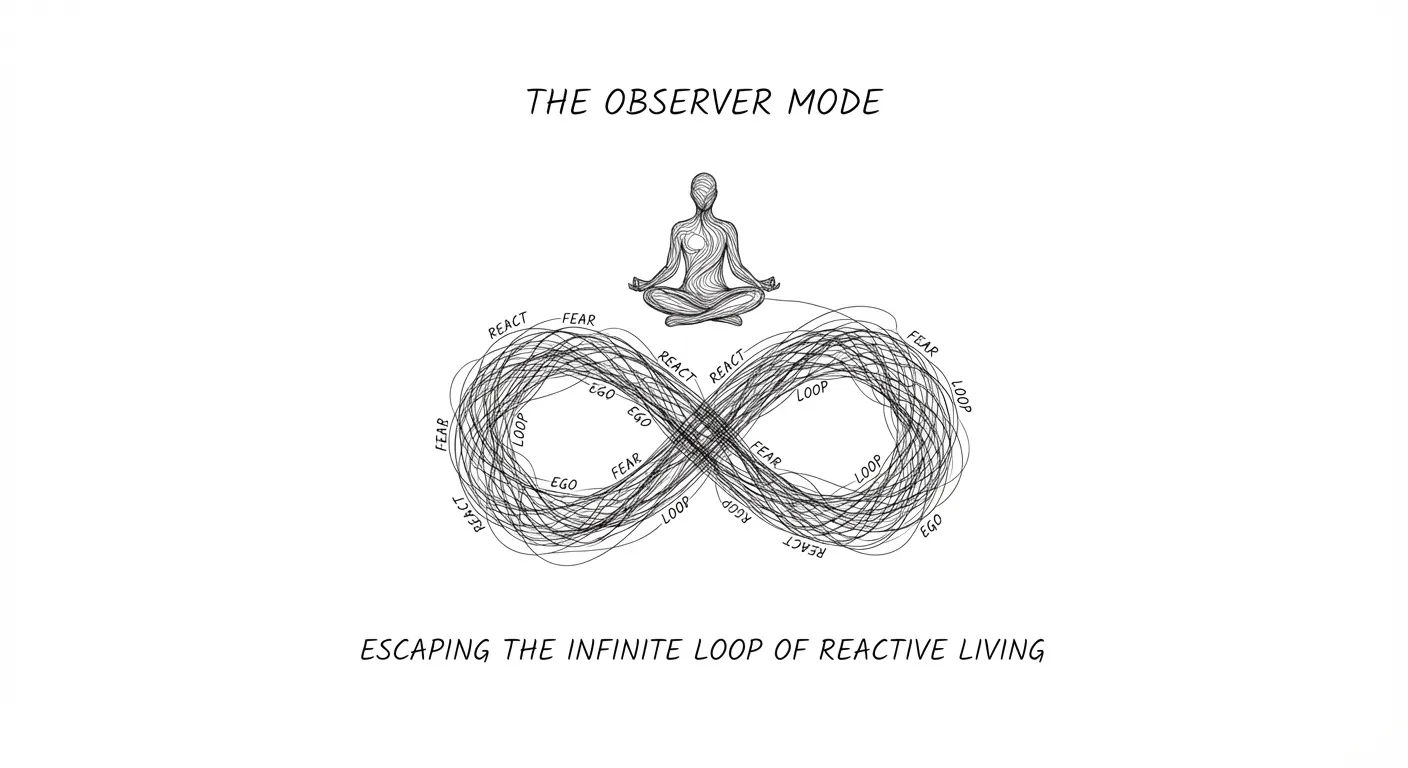
The Observer Mode: Escaping The Infinite Loop Of Reactive Living
"There was a time when I, too, was frequently lost in this 'first-person fog': feeling 'compressed' by the opinions of others and spiraling into anxiety as deadlines loomed. It wasn't until I began running an independent 'observer protocol' in the background of my mind that things changed. I discovered that those overwhelming emotions—once like crashing waves—instantly 'downgraded' into a series of analyzable data points."
曾几何时,我也常陷入这种"第一人称的迷雾”:因为别人的评论而感到被"压缩”,因为截止日期的临近而陷入焦虑。
直到我开始尝试在大脑的后台,运行一个独立的"观察程序”。
我发现,那些原本排山倒海的情绪竟然会瞬间"降级”为一串可分析的数据。
Imagine you are sitting in a 'dark, silent movie theater.'
想象一下,你正坐在一间 "漆黑、静谧的放映厅” 里。
On the big screen, a 'grand and complex movie' is playing, and the protagonist’s name is "You."
大屏幕上正播放着一部 "宏大而复杂的电影”,主角的名字叫作"你”。
In this movie, the protagonist is experiencing everything: the 'crushing weight of a career', the subtle awkwardness of social interactions, and the restless nights spent worrying about an uncertain future.
在这个电影里,主角正在经历一切:"职业生涯带来的沉重压力”,社交场合中微妙的局促感,以及为了不确定的未来而辗转反侧的无眠之夜。
As an audience member, you are completely 'immersed in the unfolding plot.'
作为观众,你完全 "沉浸在不断展开的剧情之中”。
When the protagonist cries, your eyes well up; when the protagonist is angry, your heart rate accelerates; when the protagonist feels fear, your 'muscles tense.'
当主角流泪时,你的眼眶也会湿润;当主角愤怒时,你的心跳也会加速;当主角感到恐惧时,你的 "肌肉也会随之紧绷”。
This is how the vast majority of people spend their entire lives: in a state of 'chronic over-identification' with their external circumstances.
这就是绝大多数人度过一生的方式:处于一种对外部环境长期 "过度认同” 的状态之中。
They believe they are the character, the emotions, and the 'reactive thoughts.'
他们深信自己就是那个角色,就是那些情绪,就是那些 "反射性的念头”。
But in a certain moment, the lights in the theater flicker due to a 'minor, unexpected glitch' in the system.
但在某个瞬间,电影院的灯光由于系统中一个 "微小且意料之外的故障” 而闪烁了一下。
In that millisecond, the illusion breaks, and you suddenly realize: you are not the 'flickering character' on the screen.
在那一毫秒的时间里,幻象破灭了,你突然意识到:你并不是屏幕上那个 "闪烁不定的角色”。
You are actually the 'silent witness,' sitting in the darkness, calmly observing the flow of light, shadow, and sound on the screen.
你其实是那个 "静默的见证者”,坐在黑暗中,冷静地观察着屏幕上光影与声音的流动。
This radical realization is what we are dissecting today: 'The Observer Mode.'
这种彻底的意识转折,就是我们今天要拆解的内容:"观察者模式”。
In psychology, it is strictly termed 'Metacognition'; in philosophy, it is the 'Objectification of the Subject.'
在心理学中,它被严谨地称为 "元认知”;在哲学中,它是 "主体客体化”。
This is not just a coincidental psychological experience; it is the 'master key' to unlocking the highest level of human functional capability.
这不只是一次偶然的心理体验,它是开启人类最高水平功能运作的一把 "万能钥匙”。
If you can master this mode, you will no longer be a 'biological machine' driven by ancestral instinct and environmental stimuli.
如果你能掌握这种模式,你将不再是一个被祖先本能和环境刺激驱动的 "生物机器”。
You will gain a rare power known as 'Metacognitive Sovereignty.'
你将获得一种名为 "元认知主权” 的稀缺力量。
This means you have finally gained the 'architectural authority' to modify the behavioral code of your own existence.
这意味着你终于获得了 "架构层面的权威”,去修改你自己生命存在的行为代码。
Part 1: The Prisoner of First-Person Entropy
第一部分:第一人称熵增的囚徒
Why do we desperately need this mode? Because the 'default human perspective' is a systematic disaster for long-term growth.
我们为什么迫切需要这种模式?因为人类 "默认的视角” 对于长期成长来说是一场系统性的灾难。
Our primitive brain was engineered through evolution for one purpose only: 'immediate survival and energy conservation.'
我们的原始大脑在进化过程中被设计出来只有一个目的:"即时生存与能量节省”。
To achieve this, the brain establishes extremely efficient, 'automated feedback-response loops.'
为了实现这一目标,大脑建立了极其高效且 "自动化的反馈-反应回路”。
When you feel a perceived threat, the 'amygdala' takes over immediately, bypassing your rational thought, and you enter a fight-or-flight state.
当你感受到预警威胁,"杏仁核” 会立即接管并绕过你的理性思考,让你进入战斗或逃跑状态。
The modern world is a mismatch for this ancient hardware; it triggers 'constant false alarms' through notifications and social pressures.
现代世界与这种古老的硬件并不匹配;它通过通知和社交压力触发了 "持续的虚假警报”。
When you see a dopamine-inducing digital temptation, the 'striatum activates,' and you enter an unthinking state of consumption.
当你看到诱导多巴胺的数字诱惑,"纹状体就会激活”,让你进入一种无意识的摄取状态。
This perspective is what we call the 'First-Person Participant View,' where the "I" and the "Emotion" are fused into one entity.
这种视角被我们称作 "第一人称参与者视角”,在这种视角下,"我”与"情绪”被融合进了一个实体之中。
The fatal flaw of this view is that it possesses 'zero psychological distance.'
这种视角的致命缺陷在于,它的 "心理距离为零”。
Because there is no distance, you cannot distinguish between the 'objective facts of reality' and your subjective feelings about them.
因为没有距离,你就无法区分 "现实的客观事实” 与你对这些事实的主观感受。
When stress hits, you don’t just "feel stressed"; you literally 'become the embodiment' of that stress.
当压力袭来,你不仅仅是"感到了压力”,你简直成了 "压力的化身”。
In physics, a 'closed system' will inevitably head toward entropy—chaos, decay, and disorder—if there is no external oversight.
在物理学中,一个 "封闭系统” 如果没有外部监管,必然会走向熵增——即混乱、衰败与无序。
Your life follows this exact thermodynamic rule: without 'meta-observation,' your habits default to the path of least resistance.
你的生活也遵循这一热力学规律:如果没有 "元观察”,你的习惯会默认走向阻力最小的路径。
This path leads to 'cognitive stagnation' and the erosion of personal agency.
这条路径会导致 "认知停滞” 和个人主观能动性的侵蚀。
If you only live as an internal participant, you will loop through the same 'reactive patterns' until your system collapses under its own weight.
如果你只是作为一个内部参与者生活,你将在同样的 "反应模式” 中不断循环,直到你的系统在自身的重压下崩溃。
This is why traditional willpower usually fails—'willpower is an internal resource' consumed by the system it tries to control.
这就是为什么传统的意志力往往会失效—— "意志力是内部资源”,被它试图控制的系统所消耗掉了。
The Observer Mode, however, is a 'strategic intervention' originating from outside the system’s immediate logic.
而观察者模式,是源自系统即时逻辑之外的一种 "战略性干预”。
Most people remain in a state of 'chronic frustration' because they are trying to find an exit while standing deep within the fog.
大多数人之所以长期处于 "慢性挫败感” 中,是因为当他们深陷于迷雾时,还试图寻找出口。
It’s like being lost in a dense forest: the faster you run without a map, the more 'exhausted and lost' you become.
这就像迷失在茂密的森林里:没有地图时你跑得越快,你就会变得越 "疲惫、越迷茫”。
What you lack is not effort or speed, but the 'altitude required' to see the forest's boundaries.
你缺少的不是努力或速度,而是看见森林边界所需的 "高度”。
Part 2: The Advantage of Psychological Displacement
第二部分:心理位移的优势
When we activate the Observer Mode, we are performing what scientists call a 'dimensional leap' in consciousness.
当我们开启观察者模式,我们实际上是在意识中进行一场科学家所说的 "维度跃迁”。
This mode provides us with the profound power of 'Psychological Displacement.'
这种模式为我们提供了 "心理位移” 的深层力量。
Psychological Displacement creates a vital 'buffer zone' between an environmental stimulus and your subsequent response.
心理位移在环境刺激与你随后的反应之间创造了一个至关重要的 "缓冲区”。
In a default, unexamined state, there is a 'seamless, automated connection' between what happens to you and how you react.
在默认的、未经审视的状态下,发生在你身上的事与你的反应之间存在着一种 "无缝的自动化连接”。
The Observer Mode intervenes and forces a 'necessary vacuum' into that deterministic process.
观察者模式强行介入,并在那个宿命论般的过程中注入了一个 "必要的真空地带”。
As Viktor Frankl famously noted: "'Between stimulus and response there is a space. In that space is our power to choose our response.'"
正如维克多·弗兰克尔的名言:"在刺激与反应之间有一个空间。在那个空间里,我们有权选择自己的反应。”
The Observer Mode is the 'cognitive technology' used to expand that specific space.
观察者模式就是用来扩张那个特定空间的 "认知工具”。
When you observe your anger, the anger is instantly 'downgraded' from an "absolute truth" to a "biochemical data point."
当你观察自己的愤怒,愤怒会瞬间被 "降级”,从一种"绝对真理”转变为一个"生化数据点”。
Data can be analyzed, categorized, and ignored; it no longer carries the 'authority of a command.'
数据是可以被分析、分类和忽略的;它不再具备 "指令般的权威”。
From a neurobiological perspective, this is the 'Medial Prefrontal Cortex (mPFC)' asserting dominance over the Limbic System.
从神经生物学的角度看,这是 "内侧前额叶皮层 (mPFC)” 在确立对边缘系统的统治地位。
The limbic system is ancient and impulsive, working on the logic of 'immediate gratification.'
边缘系统是古老且冲动的,它运行在 "即时满足” 的逻辑之上。
The prefrontal cortex is the 'CEO of the brain'—advanced, rational, and capable of complex simulation.
前额叶皮层是 "大脑的首席执行官” ——先进、理性,且具备复杂的模拟能力。
When you enter Observer Mode, you activate this 'executive center' to oversee lower-level biological functions.
当你进入观察者模式,你激活了这个 "执行中心” 来监督低层级的生物功能。
This area sends 'inhibitory signals' down to the emotional centers, effectively dampening the intensity of the primal urge.
该区域向下发送 "抑制信号” 给情绪中心,有效地降低了原始冲动的强度。
It says: "I receive the signal of anxiety, but I have determined it is a 'false alarm' based on current goals."
它在说:"我接收到了焦虑的信号,但根据目前的目标,我已判定这是一个 "虚假警报”。”
This shifts your entire behavioral logic from being 'biologically enslaved' to being "goal-architected."
这让你整个的行为逻辑从被 "生物奴役” 转向了"目标构建”。
You stop being a 'leaf tossed by the wind' and start becoming the wind itself.
你不再是 "随风飘荡的落叶”,而是开始成为风本身。
This transition represents the 'highest form of psychological maturity' available to our species.
这种转变代表了我们物种所能达到的 "心理成熟的最高形式”。
By observing the system, you gain the power to 'steer the system' toward intentional outcomes.
通过观察系统,你获得了 "驾驭系统” 走向预期结果的力量。
Part 3: The Gamified Protocol of the Meta-Lab
第三部分:元实验室的游戏化协议
To prevent this profound shift from remaining a mere concept, we must turn it into a 'rigorous, gamified protocol.'
为了防止这种深刻的转变仅停留在概念层面,我们必须将其变成一套 "严谨的游戏化协议”。
We treat your consciousness as a 'laboratory' where you conduct controlled experiments on your own behavior.
我们将你的意识视为一个 "实验室”,在那里你对自己行为进行受控实验。
We can divide this systematic training into 'four distinct levels' of operational mastery.
我们可以将这种系统化训练分为 "四个不同的操作等级”。
Level 1: The Third-Person Narrative.
第一级:第三人称叙述。
The first objective is to break the 'linguistic fusion' of "I" and "Action."
第一个目标是打破"我”与"行动”在 "语言上的融合”。
Instead of allowing your mind to say "I am stressed," you force a 'narrative shift' in your internal dialogue.
与其任由你的大脑说"我很压抑”,不如在你的内心对话中强加一种 "叙事转变”。
Say to yourself: "'He is experiencing an elevation in cortisol; his thoughts are racing, and he feels the urge to retreat.'"
对自己说:"他正在经历皮质醇升高;他的思绪在飞转,他感到了撤退的冲动。”
This displacement forces your consciousness to detach from the 'actor' and occupy the seat of the "director."
这种位移强制你的意识从 "演员” 中脱离,占据"导演”的位置。
Level 2: The Satellite Perspective.
第二级:卫星视角。
When you feel the sudden onset of intense emotion—shame, rage, or desire—you trigger a 'visual displacement.'
当你感受到强烈情绪的突然发作——如羞愧、愤怒或欲望——你就触发一次 "视觉位移”。
Close your eyes for one second and visualize your consciousness 'detaching from your physical body.'
闭上眼睛一秒钟,想象你的意识正从你的 "肉体中分离”。
Imagine rising 100 meters into the air, looking down at the 'small figure' of yourself in the context of the room.
想象升入百米高空,在房间的背景下俯瞰那个 "渺小的自己”。
Observe that person’s physiological state from above: the slumping shoulders, the 'shallow breathing,' the reactive movements.
从高处观察那个人的生理状态:塌陷的肩膀,"浅短的呼吸”,反射性的动作。
Ask the Observer’s question: "'In the grand system of this person’s life, how significant is this momentary spike in data?'"
问一个观察者会问的问题:"在那个人生命的宏大系统中,这一瞬间的数据峰值究竟有多重要?”
This practice 'de-escalates the nervous system' by re-contextualizing the immediate crisis.
这种练习通过重塑即时危机的背景,"降低了神经系统的紧张程度”。
Level 3: The Algorithmic Tagging.
第三级:算法标记。
De-mystify your biological impulses by giving them 'clinical labels' as if they were software glitches.
给你的生物冲动贴上 "临床标签”,就好像它们是软件故障一样,以此消除它们的神秘感。
When you feel the urge to seek a cheap reward, tag it: "'Systemic Loop: Seeking low-effort gratification detected.'"
当你产生寻求廉价回报的冲动时,标记它:"系统回路:检测到正在寻求低努力满足感。”
When you feel a defensive urge during a conversation, tag it: "'Primitive Ego-Defense Protocol initiated.'"
当你在交谈中感到防御冲动时,标记它:"原始自我防御协议已启动。”
The goal is to view these impulses as 'pre-installed biological software' running outdated scripts.
其目标是将这些冲动视为 "预装的生物软件” 在运行陈旧的程序。
This level of practice creates a 'mental firewall' against impulsive decision-making.
这一层级的练习建立了一道对抗冲动决策的 "意识防火墙”。
Level 4: The Strategic Intervention.
第四级:战略干预。
This is the peak of 'behavioral architecture,' where you intervene in the system's execution.
这是 "行为架构” 的巅峰,在这里你干预系统的执行。
When the Observer catches a recurring, destructive loop, you force a 'circuit breaker'—a conscious action.
当观察者捕捉到一个反复出现的、破坏性的回路时,你强制执行一个 "断路器” ——一个有意识的行动。
If the "anger script" starts running, the Observer doesn’t try to 'fight the anger directly.'
如果"愤怒程序”开始运行,观察者不会试图 "直接对抗愤怒”。
Instead, the Observer commands: "'Perform a system check: drink 200ml of water and count five blue objects.'"
相反,观察者命令:"执行系统检查:喝200毫升水,并数出五个蓝色的物体。”
By overriding a biological impulse with a 'conscious, arbitrary command,' you establish Metacognitive Sovereignty.
通过用一个 "有意识的、随机的命令” 覆盖生物冲动,你确立了元认知主权。
This is how you move from being a 'biological proxy' to a conscious architect of your own reality.
这就是你如何从一个 "生物代理人” 转变为你自身现实的有意识建筑师。
Conclusion: From Reaction to Architecture
结语:从反应到架构
In this hyper-stimulated world, the most valuable asset you can own is the ability to remain 'un-captured' by your reactivity.
在这个过度刺激的世界里,你能拥有的最有价值的资产就是保持不被自身反应性所 "捕获” 的能力。
The Observer Mode does not rob your life of its emotion; rather, it gives you the 'clarity' to see the palette.
观察者模式并不会剥夺你生活的色彩;相反,它赋予你看见调色板的 "清晰视野”。
When you observe your joy, the joy becomes deeper and more objective, free from 'desperate attachment.'
当你观察自己的快乐,快乐会变得更深邃、更客观,不再带有 "绝望的执着”。
When you observe your suffering, the suffering loses its weight because it is no longer 'entangled' with your identity.
当你观察自己的痛苦,痛苦就会失去重量,因为它不再与你的身份 "缠绕” 在一起。
You are no longer a victim of the 'First-Person Fog,' wandering aimlessly through a forest of impulses.
你不再是 "第一人称迷雾” 的受害者,在冲动的森林中漫无目的地徘徊。
Step back from the 'screen' of your immediate experience.
从你即时体验的 "屏幕” 前退后一步。
Rise up into the silent theater of the 'meta-mind.'
升入元意识那静谧的 "放映厅”。
Observe the version of yourself that is striving, failing, fearing, and hoping, with 'total equanimity.'
以 "完全的平和” 去观察那个正在努力、失败、恐惧和希望着的自己。
When you truly perceive the 'automated trajectory' of the participant, you possess the power to rewrite the destiny of the system.
当你真正洞察了参与者的 "自动化轨迹”,你便拥有了重写系统命运的力量。
'Stay Sovereign. Observe the System. Build your own Architecture.'
"保持主权。观察系统。构建你自己的架构。”
Thank you for listening to today’s'deep dive.'
感谢收听今天的"深度长文”。
Next time you feel yourself being'pulled away by an external force,'remember to ask yourself this question:
下一次当你感到自己即将被"某种力量拉走”时,记得问自己那个问题:
"'The one who is observing all of this—what are they seeing right now?'"
"那个正在观察这一切的人,他现在看到了什么?”
I’ll see you in the'next one.'
我们"下次再见”。