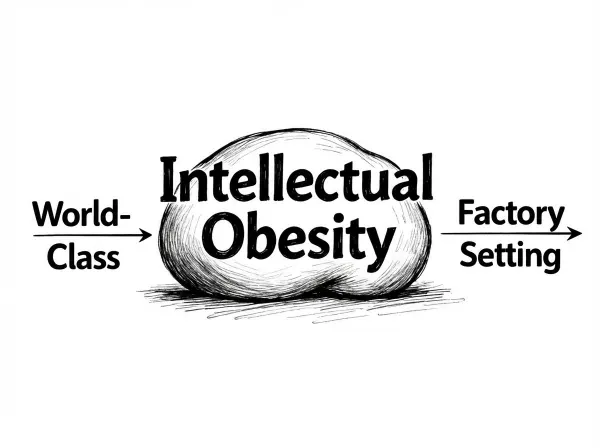
Intellectual Obesity: Why you can't change (Code fixes it).
Your input is world-class, but your output is factory settings. Cure. Intellectual Obesity, not by willpower, but by installing the 'If-Then' Code.
"I once suffered from "intellectual obesity": devouring self-mastery
content by day, but stuck in endless algorithm feeds at night. I realized I
wasn’t learning—just loading mental bloatware. In the face of eons of
evolution, willpower is as weak as paper."
我曾经深陷这种"知识肥胖症”:白天在播客里听着自律与专注,深夜却在算法推荐的短视频里无法自拔。
那一刻我意识到,我并不是在"学习”,而是在给日益臃肿的认知系统增加负担。
所谓的意志力,在几十万年的生物进化本能面前,脆弱得就像一张纸。
Part 1: The Fault
第一部分:故障
Deep breath
深吸一口气
I want to talk to you about a phenomenon unique to modern civilization: Intellectual Obesity.
我想和你谈谈一种现代文明特有的现象:知识肥胖症” (Intellectual Obesity)。
Look at your phone.
看看你的手机。
The bookmarks filled with articles on "Deep Work"? The Watch Later list stacked with videos on "Emotional Management"?
收藏夹里,躺着关于"深度工作”的文章?稍后读列表里堆满了关于"情绪管理”的视频?
The books on "Self-Discipline" sitting on your shelf, still wrapped in plastic?
书架上那些关于"自律”的书籍,连塑封都还没拆?
We consume massive amounts of information every day. You are listening to this podcast, which makes you feel industrious, makes you feel like you are "leveling up."
我们每天都在摄入大量的信息。你在听这期播客,这让你感觉自己很勤奋,让你觉得正在"升级”。
Your brain’s dopamine circuits are frantically rewarding this sensation of I am learning.
你的大脑多巴胺回路正在疯狂奖赏这种我在学习的感觉。
But let’s turn off the filter and look at the naked reality.
但让我们把滤镜关掉,看看赤裸的现实。
When the alarm rings on Monday morning, your fingers subconsciously hit the snooze button—even though you watched a video on "How Waking Up Early Changes Your Life" last night.
当周一早上的闹钟响起,手指还是下意识地按下了贪睡键——尽管昨晚刚看了一个关于"早起改变人生”的视频。
When that difficult project is in front of you, your hand involuntarily reaches for the phone—even though you just finished reading Atomic Habits.
当那个棘手的项目摆在面前,手还是不自觉地伸向了手机——尽管刚刚读完《原子习惯》。
When your partner says something stinging, your emotions explode instantly—even though you know "Nonviolent Communication" by heart.
当伴侣说了一句刺耳的话,情绪依然瞬间爆发——尽管对"非暴力沟通”倒背如流。
Do you see the Glitch here?
发现这里面的故障了吗?
Our "Input" might be world-class, but our Output" is still stuck on factory settings.
我们的"输入”端即使是世界级的,但输出端依然是出厂设置。
This is the ultimate dilemma of the modern human:
这就是现代人的终极困境:
We are giants in cognition, yet infants in action, still bound by primitive instincts.
我们在认知上是巨人,在行动上却依然被原始本能捆绑。
The Matrix has implanted the biggest misconception in your mind: It makes you mistake "Knowing" for "Doing.
Matrix(矩阵)给我们植入了一个最大的误区:它让你误以为"知道”就是"做到。
The reason you find change so difficult is not because you lack knowledge, nor because you lack so-called "motivation" or "willpower."
你之所以感到改变如此艰难,不是因为你缺乏知识,也不是因为你缺乏所谓的"动力”或"意志力”。
Please stop blaming yourself. This is not your fault.
请停止责备自己。这不是你的错。
The root of the struggle is that you are trying to run outdated hardware from millions of years ago using the wrong software.
困难的根源在于,你正在试图用错误的软件,去运行一台几百万年前的硬件。
Your brain, from an evolutionary perspective, does not care if you are "successful" or "disciplined."
你的大脑,从生物进化的角度来看,根本不在乎你是否"成功”、是否"自律”。
Its only design purpose is Survival and Energy Conservation.
它被设计的唯一目的,是生存和节能。
Every time you try to apply new knowledge, every time you try to fight instinct, you are burning an extremely expensive fuel— Cognitive Resources.
每一次你想应用新知识,每一次你想对抗本能,你都在消耗一种极其昂贵的燃料——认知资源。
And your brain, out of a survival instinct, will do everything possible to stop you from burning this fuel.
而你的大脑,出于生存本能,会想尽一切办法阻止你消耗这种燃料。
So, when you try to brute-force it with "willpower" alone, you are essentially engaging in hand-to-hand combat with millions of years of evolutionary mechanisms.
所以,当你试图单靠"意志力”去硬扛时,你其实是在和几百万年的进化机制肉搏。
This is an asymmetric war. By brute force, the odds of winning are extremely low.
这是一场不对称的战争。靠蛮力,胜算极低。
Unless, you learn to Rewrite the Code.
除非,你学会改写代码。
Part 2: The Source Code
第二部分:源代码逻辑
If we view the human body as a sophisticated biological computer, then most people are running a set of Legacy Code full of bugs.
如果我们把人体看作一台精密的生物计算机,那么大部分人都在运行一套充满 Bug 的旧脚本 (Legacy Code)。
This legacy code was designed for jungle survival:
这套旧脚本是为了丛林生存设计的:
-
Input: Feel Stress -> Output: Seek high-calorie food / Dopamine (scrolling).
-
Input: Encounter Difficulty -> Output: Conserve Energy (Procrastination).
-
Input: Feel Threat -> Output: Fight or Flight (Anger).
-
Input:感到压力 -> Output:寻找高热量食物 / 多巴胺(刷手机)。
-
Input:遇到困难 -> Output:节省能量(拖延)。
-
Input:感到威胁 -> Output:战斗或逃跑(愤怒)。
This is an automated response mechanism. This is called a "Habit."
这是一套自动化的反应机制。这叫"习惯”。
How do you usually try to change this mechanism?
你想改变这套机制,通常的做法是什么?
You try to forcibly insert something called Willpower between the Input and the Output.
你试图在 Input 和 Output 之间强行插入一个叫意志力的东西。
You try to tell yourself when you are angry: "Hold it! Hold it!"
你试图在愤怒的时候告诉自己:"忍住!忍住!”
This is like trying to stop a speeding train with your bare hands.
这就像是你试图用手去阻挡一辆正在高速行驶的火车。
When you are in a good state and fully charged, you might stop it once.
当你的状态好、电量足的时候,你也许能挡住一次。
But when you are tired or hungry, the willpower defense line will be breached, and the old habits will take over the body again.
但当你累了、饿了,意志力这道防线就会失守,旧的习惯会再次接管身体。
We need a smarter strategy.
我们需要一种更聪明的策略。
We need to think like a programmer.
我们需要像程序员一样思考。
Programmers don't sit in front of a computer trying to fix bugs with their mind. Programmers rewrite the code.
程序员不会坐在电脑前,用意念去修复 Bug。程序员会重写代码。
In psychology, this tool is called Implementation Intentions.
在心理学界,这个工具被称为执行意图 (Implementation Intentions)。
But I prefer to call it: The Conditional Statement of the Brain.
但我更愿意称之为:大脑的条件语句 (The Conditional Statement)。
The underlying logic of computers is: If This, Then That.
计算机的底层逻辑是:If This, Then That. (如果这样,就那样。)
This is not just a sentence structure.
This is a Transfer of Power.
这不仅仅是一个句式。
这是一种权力的转移。
When you set a vague goal, like "I want to be healthy," it is just a wish. Your brain doesn't know how to execute "Healthy."
当你制定一个模糊的目标,比如"我要保持健康”,这只是一个美好的愿望。你的大脑不知道该怎么执行"健康”。
But when you write a line of code:
但当你写下一行代码:
If I finish reading this page, Then I will do five push-ups.
如果我看完了这一页书,我就做五个俯卧撑。
Notice what happens here.
注意这里发生了什么。
You have outsourced the power to control behavior from the "Subjective Self"—which is easily exhausted and swayed by emotions—to the absolutely objective, cold Environment Cue.
你把控制行为的权力,从那个容易疲惫、会被情绪左右的"主观自我”,外包给了绝对客观、冰冷的环境线索。
Once the condition is met, the program runs automatically.
一旦条件满足,程序自动运行。
No decision making. No hesitation. No asking yourself "Do I feel like doing it."
不需要决策。不需要犹豫。 不需要问自己"我想不想做”。
It’s like flipping a switch; the light turns on. Your behavior is "automated."
就像你按下开关,灯就会亮一样。你的行为被"自动化”了。
This is how High-Level Players play the game:
这就是高阶玩家的游戏方式:
They don't rely on motivation derived from fluctuating states; they rely on Systems.
他们不依赖由于状态波动而产生的动力,他们依赖系统。
Part 3: Writing The Script (The Three Rules)
第三部分:编写脚本的三个法则
Okay, now let’s get practical.
好,现在我们进入实操。
How do you write this line of code that can change your behavioral patterns?
如何编写这行能改变你行为模式的代码?
To ensure the code runs, we need to follow three rules.
为了确保代码能运行,我们需要遵循三个法则。
Rule 1: If must be High-Fidelity Cues.
法则一:If 必须是高清的 (High-Fidelity Cues)
Many people's code is: "If I want to go for a run..."
很多人的代码是:"如果我想去跑步……”
Stop.
停。
"Want" is a feeling. Feelings are fluid and unreliable.
"想”是一个感觉。感觉是流动的、不可靠的。
If you want the program to run, you must anchor it to Physical Reality.
如果你想让程序运行,你必须锚定物理现实。
You need to find nodes that are guaranteed to happen:
你需要寻找那些必然发生的节点:
- Not "If I have time," but If my butt hits the office chair.
不是"如果我有空”,而是如果我屁股坐到了办公椅上。 - Not "If I want water," but If I pick up my water cup.
不是"如果我想喝水”,而是如果我拿起了水杯。 - Not "If I'm in a bad mood," but If I feel my breathing becoming rapid.
不是"如果心情不好”,而是如果我感到呼吸变得急促。
The clearer the cue, the higher the trigger rate.
线索越清晰,触发率就越高。
Rule 2: Then must be Low-Friction Action.
法则二:Then 必须是低阻力的 (Low-Friction Action)
This is where the system usually crashes.
这是最容易导致死机的地方。
"If it's 8 PM, Then I will start writing that 10,000-word thesis."
"如果晚上 8 点,我就开始写那篇一万字的论文。”
Your brain sees this code and immediately sounds the alarm. Because "writing a thesis" is a massive threat. Your biological instincts will revolt.
你的大脑看到这行代码会立刻报警。因为"写论文”是一个巨大的威胁。你的生物本能会疯狂反抗。
Remember, the purpose of If-Then is not to Finish the task, but to Start the task.
记住,If-Then 的目的不是为了完成任务,而是为了启动任务。
We are conquering static friction.
我们要攻克的是静摩擦力。
Your code should be:
你的代码应该是:
- If it's 8 PM, Then I will open the computer, create a new document, and write the title.
如果晚上 8 点,我就打开电脑,新建一个文档,写下标题。 - If I want to go to the gym, Then I will put on my running shoes and stand at the door.
如果我想去健身,我就穿上跑鞋,站在门口。
This step must be so simple that you feel it takes "no effort at all."
这一步必须简单到让你觉得"不费吹灰之力”。
Once you put on the shoes, once you write the title, inertia will push you to walk the rest of the path.
一旦你穿上了跑鞋,一旦你写下了标题,惯性就会推着你走完剩下的路。
Don't try to build Rome; you just need to lay the first brick.
不要试图造一座罗马,你只需要搬第一块砖。
Rule 3: Write the "Else Statement" (The Crash Patch).
法则三:编写"防崩溃补丁” (The Else Statement)
Life is full of uncertainty (Entropy).
生活充满了不确定性(Entropy)。
You want to work, a friend invites you to game. You want to diet, a colleague shares birthday cake.
你想工作,朋友喊你打游戏。你想节食,同事过生日分蛋糕。
If there is no backup plan, the system will crash.
如果没有预案,系统就会崩溃。
You need to write Defensive Code:
你需要编写防御性代码:
- If I want to pick up my phone to scroll, Then I will put the phone screen-down on the table and take three deep breaths.
如果我想拿起手机刷短视频,就先把手机屏幕朝下扣在桌子上,深呼吸三次。 - If a colleague hands me dessert, Then I will immediately say, 'Thanks, but I'd prefer a black coffee right now.'
如果同事给我递甜点,就立刻说‘谢谢,但我现在更想喝杯黑咖啡’。
You must make the decision for your future self—who might encounter temptation—while you are calm.
你要在冷静的时候,预判未来的那个你可能遇到的诱惑,并提前帮他做决定。
This is called Pre-decision.
这叫预决策 (Pre-decision)。
Part 4: The Algorithm of Focus
第四部分:聚焦算法——场景模拟
Let’s apply this system to the three scenarios you want to solve the most.
让我们把这套系统应用到你最想解决的三个场景里。
Scenario 1: The Abyss of Distraction
场景一:深渊般的注意力涣散
Do you feel it’s hard to focus for more than 10 minutes?
你是否感觉很难专注超过 10 分钟?
Don't try to force focus with "grit."
不要试图靠"毅力”强行专注。
Write this line of code:
写下这行代码:
If my eyes leave the computer screen to look at my phone, Then I will immediately pick up the pen nearby and draw a circle on paper.
如果我的视线离开了电脑屏幕想看手机,我就立刻拿起身边的笔,在纸上画一个圆。
This action of drawing a circle is an Interrupt Pattern. It cuts off your path to distraction and pulls you back to the present.
这个画圆的动作,是一个中断符。它切断了你滑向分心的路径,把你拉回当下。
Scenario 2: Emotional Outbursts
场景二:情绪的暴走
Do you easily get hijacked by your amygdala in intimate relationships and say things you regret?
你是否在亲密关系中,容易被杏仁核劫持,说出后悔的话?
Write this line of code:
写下这行代码:
If I hear the other person say the words 'You always,' or feel my face getting hot, Then I will shut my mouth, press my tongue to the roof of my mouth, and count to five.
如果我听到对方说‘你总是’这三个字,或者感到脸部发烫,我就立刻闭嘴,把舌头顶在上颚,默数五个数。
These five seconds are the time for reason to return.
这五秒钟,就是理智回归的时间。
Scenario 3: The Procrastination of Not Starting
场景三:无法开始的拖延
Have a project you must do, but you keep putting it off?
有一个必须要做的项目,但你一直拖着?
Implant this code into the cracks of your life:
把这行代码植入你的生活缝隙:
If I finish showering and drying my hair (a guaranteed action), Then I will immediately sit at the desk and open that project folder.
如果我洗完澡吹干了头发(必然发生的动作),我就立刻坐到书桌前打开那个项目文件夹。
Don't give yourself the right to choose. Turn it into a physiological procedure like brushing your teeth.
不要给自己选择权。把它变成像刷牙洗脸一样的生理程序。
Part 5: Escape The Matrix
第五部分:逃离矩阵
Finally, let’s talk about why we are doing this.
最后,我们来聊聊为什么要这么做。
You might ask:
"By turning life into lines of code, will I become a robot? Where is my freedom? Where is my spontaneity?”
你可能会问:
"把生活变成一行行代码,我会不会变成一个机器人?我的自由呢?我的随性呢?”
This is a huge misunderstanding.
这是一个巨大的误解。
Spontaneity is often not freedom, but slavery to instinct.
随性往往不是自由,而是沦为本能的奴隶。
When you are fed by algorithmic recommendations, scrolling through videos you don't want to watch, are you free?
当你被算法推荐喂养,刷着你并不想看的视频时,你是自由的吗?
When you are led by the nose by emotions, hurting the people you love, are you free?
当你被情绪牵着鼻子走,伤害你最爱的人时,你是自由的吗?
When you are controlled by biological instincts, looking at the unsatisfied state of yourself in the mirror, are you free?
当你被生物本能控制,看着镜子里对自己不满意的状态时,你是自由的吗?
No. In those moments, we are running someone else's code, or the code of primitive genes.
In those moments, we are just NPCs.
不。那些时刻,我们在运行别人的代码,或者原始基因的代码。
那时候,我们只是 NPC。
True freedom is Self-Mastery.
真正的自由,是自我主宰 (Self-Mastery)。
Freedom is having the ability, in this present moment, to use your rationality to set rules for the future self who might fall into unconsciousness or seek comfort.
自由,是你有能力在当下的这一刻,利用你的理性,为未来的那个可能陷入无意识、追求舒适的自己,制定规则。
It is designing a system that protects you from external noise and internal desires, allowing you to focus on what you truly want to create.
是你设计了一套系统,保护你免受外界噪音和内在欲望的干扰,让你能够专注于你真正想创造的东西。
"Implementation Intentions" are not meant to bind you.
"执行意图”不是要束缚你。
They are meant to liberate you from low-level biological reactions.
它是为了把你从低级的生物反应中解放出来。
They automate the trivialities of your life, freeing up precious bandwidth to think, to create, and to love specific people.
它把你生活中的琐事自动化,从而腾出宝贵的精力,去思考,去创造,去爱具体的人。
So, the mission now is clear.
所以,现在的任务很清楚了。
Close this podcast, and do not look for the next source of dopamine.
关掉这期播客后,不要去寻找下一个多巴胺来源。
Take out your notes.
拿出你的备忘录。
Pick one thing you want to change the most.
Write that line of code:
挑出一件你最想改变的事。写下那行代码:
If [Trigger], Then [Action].
如果 [触发],就 [行动]。
Don't just store it in your phone.
不要只是把它存在手机里。
Run it in your mind through Visualization, imagine the scene, feel the action.
要在脑海里通过可视化运行它,想象那个场景,感受那个动作。
You are not just writing a plan.
你不仅仅是在写计划。
You are Rewriting Your Biological Source Code.
你是在重写你的生物源代码。
You are awakening from an NPC to become a Player.
你是在从 NPC 觉醒成为 Player。
Game on.
游戏开始。